Presentation on Model Railway Photography - Slide01  Firstly, I have no professional expertise in photography but I have taken a lot of photographs over a long period of time.  Being a railway enthusiast and modeller one of the key tools needed is a camera and the ability to take good photographs for future reference.  In TCH 142 there is an article by Mike McHugh on how one can get reasonable photos using a small simple digital camera – that article covers the use of such cameras very well. The article is also now on our BRMA website. Basically is deals with cameras where you can’t make much in the way of adjustment. So if your camera is a basic point and shoot then the article by Mike is very much for you.  The cameras I use are more sophisticated so we can make those additional features work for us. In this presentation I’m focussing on photographing layouts rather than individual models.
1 Firstly, I have no professional expertise in photography but I have taken a lot of photographs over a long period of time.

Being a railway enthusiast and modeller one of the key tools needed is a camera and the ability to take good photographs for future reference.

In TCH 142 there is an article by Mike McHugh on how one can get reasonable photos using a small simple digital camera – that article covers the use of such cameras very well. The article is also now on our BRMA website. Basically is deals with cameras where you can’t make much in the way of adjustment. So if your camera is a basic point and shoot then the article by Mike is very much for you.

The cameras I use are more sophisticated so we can make those additional features work for us. In this presentation I’m focussing on photographing layouts rather than individual models.
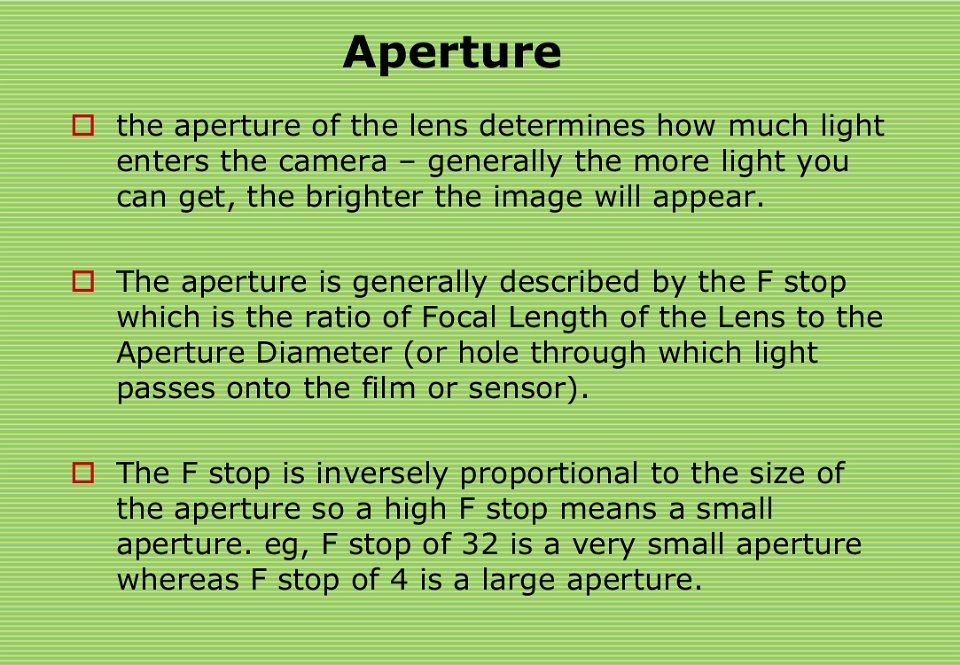
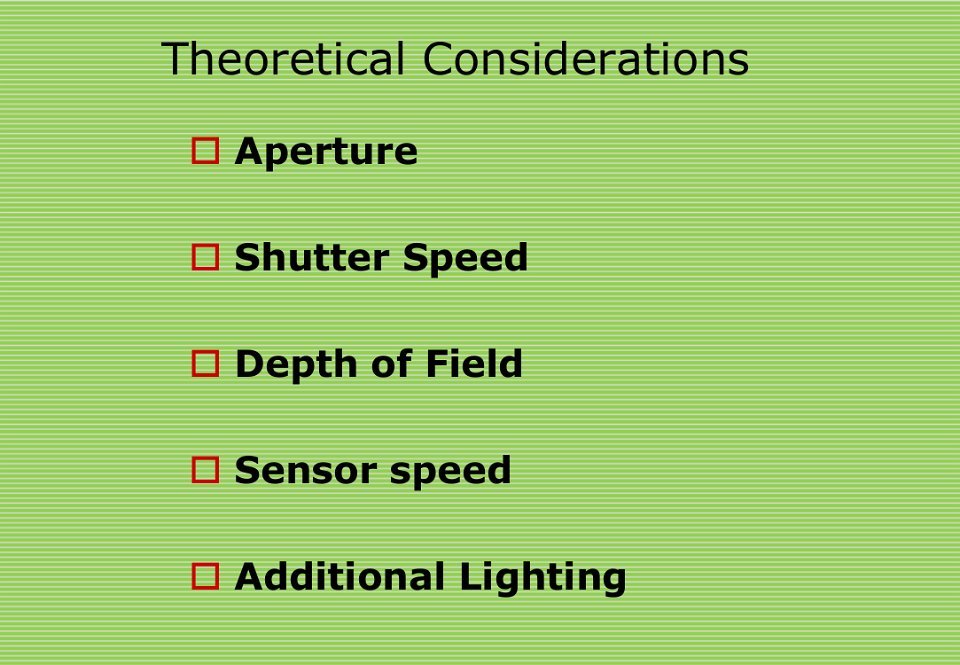
Presentation on Model Railway Photography - Slide02  Theoretical considerations...
2 Theoretical considerations...
Presentation on Model Railway Photography - Slide03  Theory
3 Theory
Presentation on Model Railway Photography - Slide04
4
Presentation on Model Railway Photography - Slide05
5
Presentation on Model Railway Photography - Slide06
6
Presentation on Model Railway Photography - Slide07
7
Presentation on Model Railway Photography - Slide08  Nikon D7000 – bought about 6 years ago as a replacement for my earlier Nikon D70S – its quite large and heavy which are its main drawbacks.  Canon G12 – this camera was recommended by Phil Parker during his visit 3 years ago, so I purchased a second-hand one for $150. It has a manual mode so that you can use the smallest aperture which is only f/8 – doesn’t sound particularly small but the small sensor format of these cameras provides a greater depth of field because the degree of magnification required is less.   Anyone taking close up photographs knows that depth of field reduces dramatically when closing in on a subject for exactly the same reason. Magnification increases as subject distance is reduced and depth of field reduces also.  Magnification in this context means the ratio of the subject height to the height of the image formed. Thus, the smaller the image format of the camera, the greater the depth of field, all other factors being equal (f-ratio, distance, and lens angle of view). Compact digital cameras with extremely tiny sensors inherently give greater depth of field, even when fitted with a wide-aperture lens.
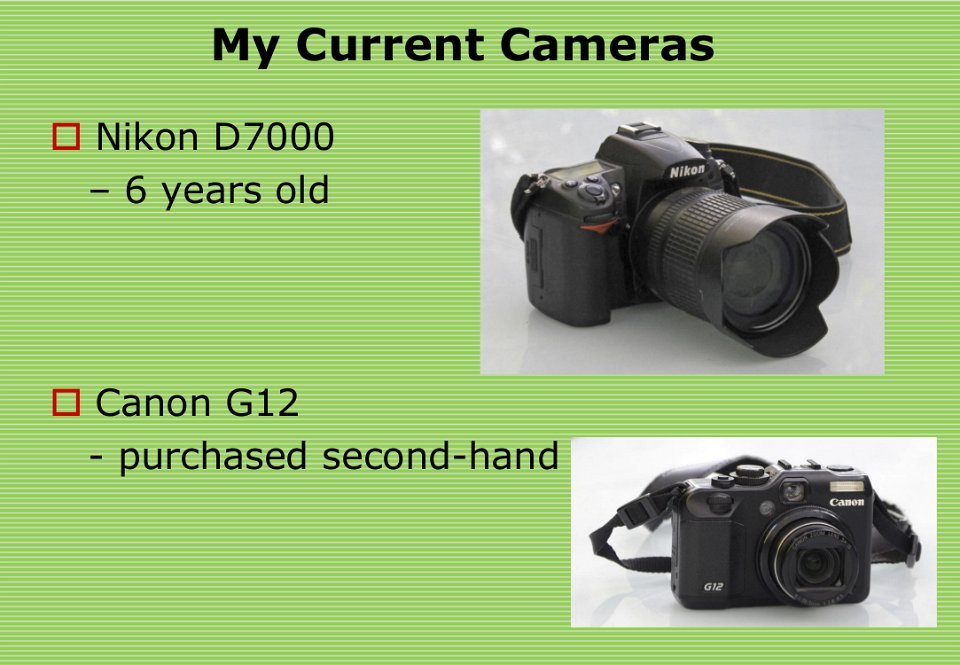
8 Nikon D7000 – bought about 6 years ago as a replacement for my earlier Nikon D70S – its quite large and heavy which are its main drawbacks.

Canon G12 – this camera was recommended by Phil Parker during his visit 3 years ago, so I purchased a second-hand one for $150. It has a manual mode so that you can use the smallest aperture which is only f/8 – doesn’t sound particularly small but the small sensor format of these cameras provides a greater depth of field because the degree of magnification required is less.

Anyone taking close up photographs knows that depth of field reduces dramatically when closing in on a subject for exactly the same reason. Magnification increases as subject distance is reduced and depth of field reduces also.
Magnification in this context means the ratio of the subject height to the height of the image formed. Thus, the smaller the image format of the camera, the greater the depth of field, all other factors being equal (f-ratio, distance, and lens angle of view). Compact digital cameras with extremely tiny sensors inherently give greater depth of field, even when fitted with a wide-aperture lens.
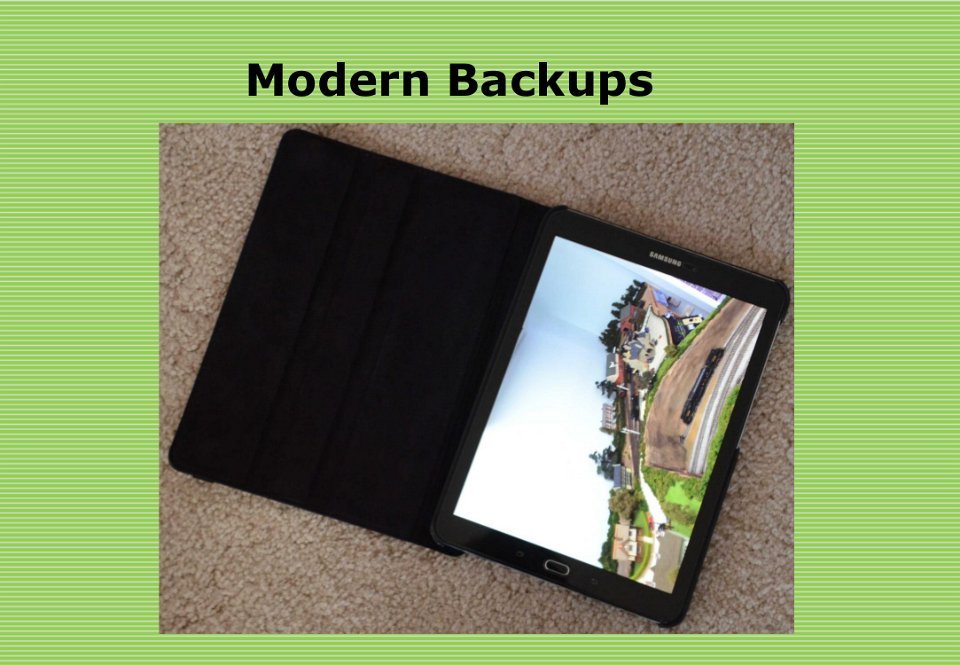
Presentation on Model Railway Photography - Slide09  My Samsung tablet can be used but is not my preference for model railway photography.  The rear camera in the Samsung Galaxy S2 is 8MP so it can be used as a back up.  Of course a smart phone can be used and some of the recent ones have really good cameras but from what I’ve seen they’re still not ideal for model photography – I might be proved wrong?    Samsung Galaxy S2 – backup if all else fails.  I don’t have a smart phone – I’ve tried to stay away from that so my mobile phone‘s camera is virtually useless. Gavin Thrum took a lot of photos on his I-phone whilst we were in the UK earlier in the year but wasn’t overly happy with the model photos I think.
9 My Samsung tablet can be used but is not my preference for model railway photography. The rear camera in the Samsung Galaxy S2 is 8MP so it can be used as a back up.

Of course a smart phone can be used and some of the recent ones have really good cameras but from what I’ve seen they’re still not ideal for model photography – I might be proved wrong?

Samsung Galaxy S2 – backup if all else fails.

I don’t have a smart phone – I’ve tried to stay away from that so my mobile phone‘s camera is virtually useless. Gavin Thrum took a lot of photos on his I-phone whilst we were in the UK earlier in the year but wasn’t overly happy with the model photos I think.
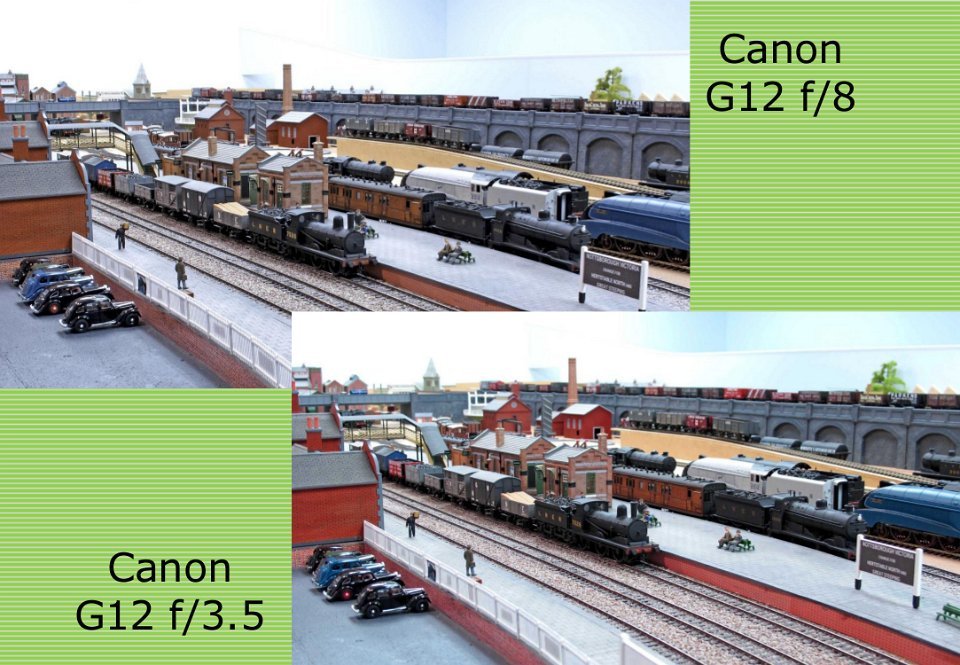
Presentation on Model Railway Photography - Slide10  Comparison between smallest aperture on the Canon and a larger aperture (it actually opens out to f2.8) but you can see there is not that much difference between f8 and f3.5.  Look closely at the station nameboard in the bottom right corner and the church and chimney in the background for the comparison.
10 Comparison between smallest aperture on the Canon and a larger aperture (it actually opens out to f2.8) but you can see there is not that much difference between f8 and f3.5. Look closely at the station nameboard in the bottom right corner and the church and chimney in the background for the comparison.
Presentation on Model Railway Photography - Slide11  Comparison between smallest aperture on the Nikon and f8 – this shows quite a large difference in depth of field.
11 Comparison between smallest aperture on the Nikon and f8 – this shows quite a large difference in depth of field.
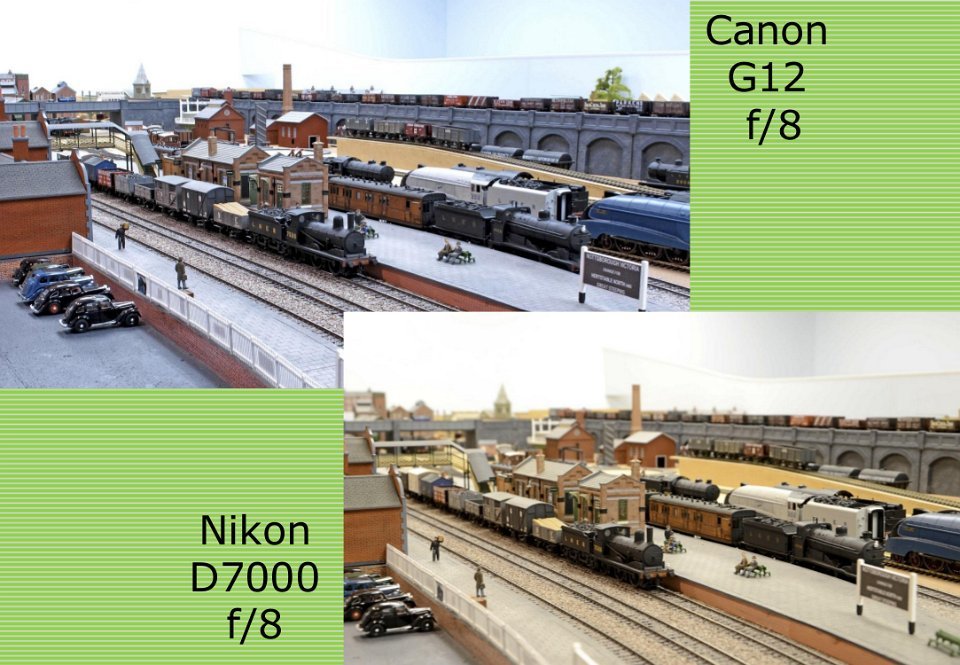
Presentation on Model Railway Photography - Slide12  Now comparing the Canon with the Nikon  - both set to f8 shows that there is substantial difference with much greater depth of field from the Canon. The difference in colour between the two cameras is due the light balance which I normally leave on automatic.
12 Now comparing the Canon with the Nikon - both set to f8 shows that there is substantial difference with much greater depth of field from the Canon.
The difference in colour between the two cameras is due the light balance which I normally leave on automatic.
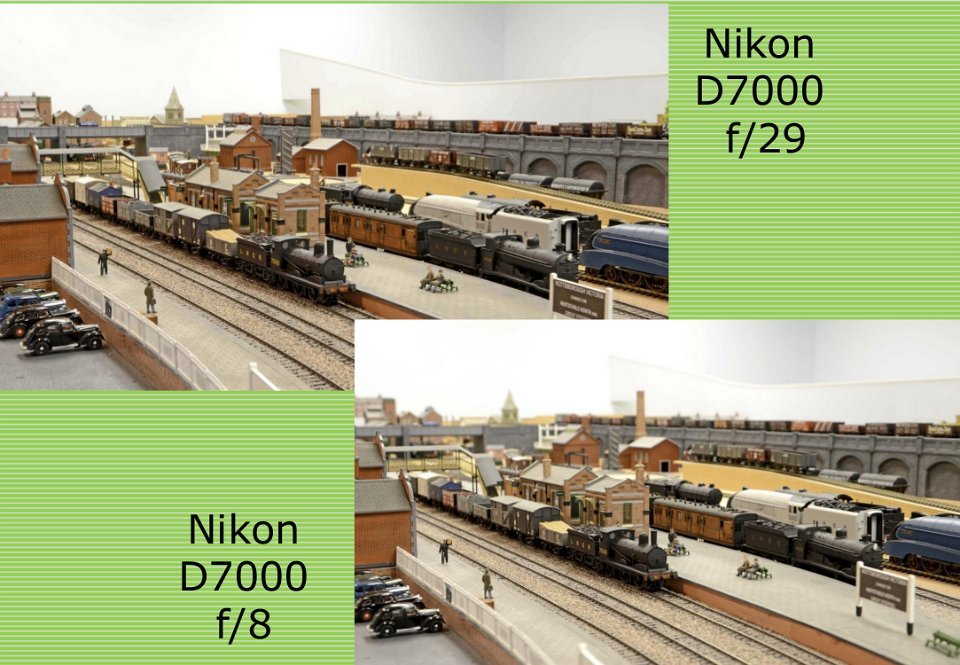
Presentation on Model Railway Photography - Slide13  Even comparing the Canon at f8 with the Nikon at f29 shows not much difference.
13 Even comparing the Canon at f8 with the Nikon at f29 shows not much difference.
Presentation on Model Railway Photography - Slide14
14
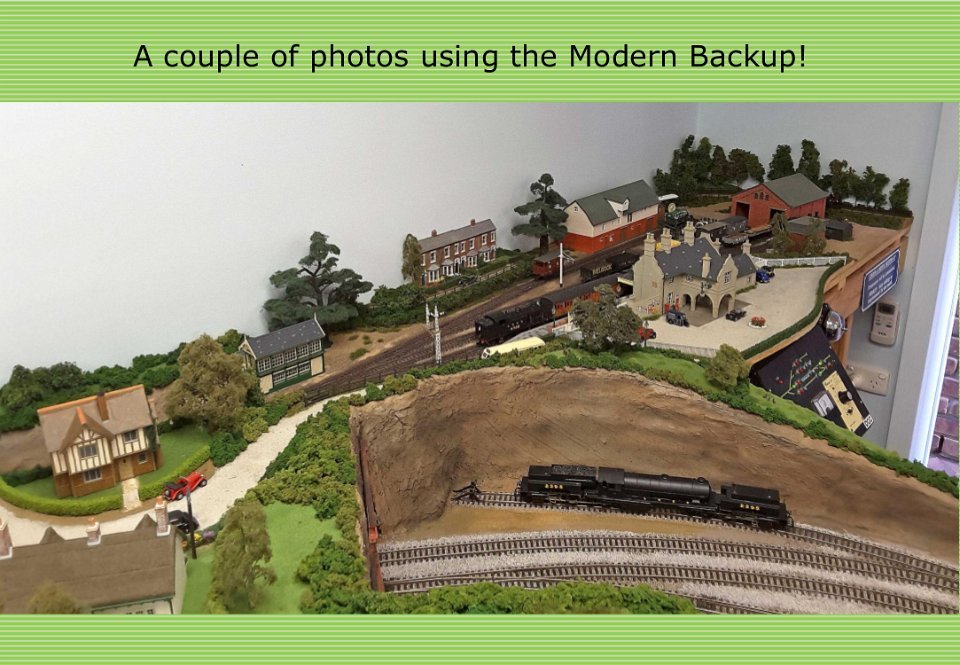
Presentation on Model Railway Photography - Slide15  A photo of one corner of my layout taken on the tablet – its has a very wide angle lens and this helps with the depth of field.
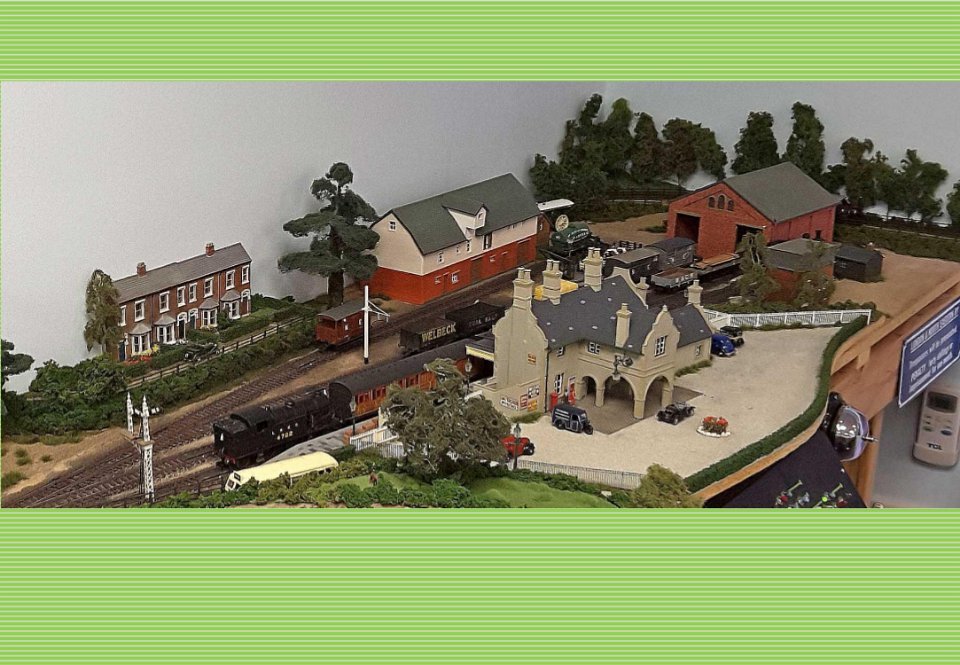
15 A photo of one corner of my layout taken on the tablet – its has a very wide angle lens and this helps with the depth of field.
Presentation on Model Railway Photography - Slide16  The previous photo cropped to show only the branch station. Its quite 'noisy' in the lower light and you’re not going to be able to use it for publication but still a useful backup if other cameras fail.
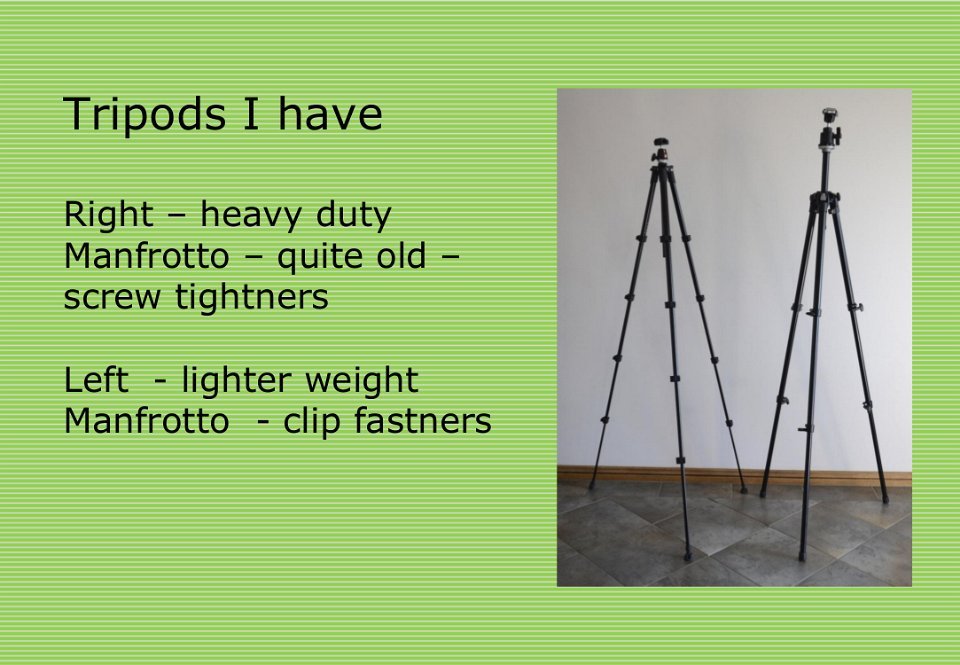
16 The previous photo cropped to show only the branch station. Its quite 'noisy' in the lower light and you’re not going to be able to use it for publication but still a useful backup if other cameras fail.
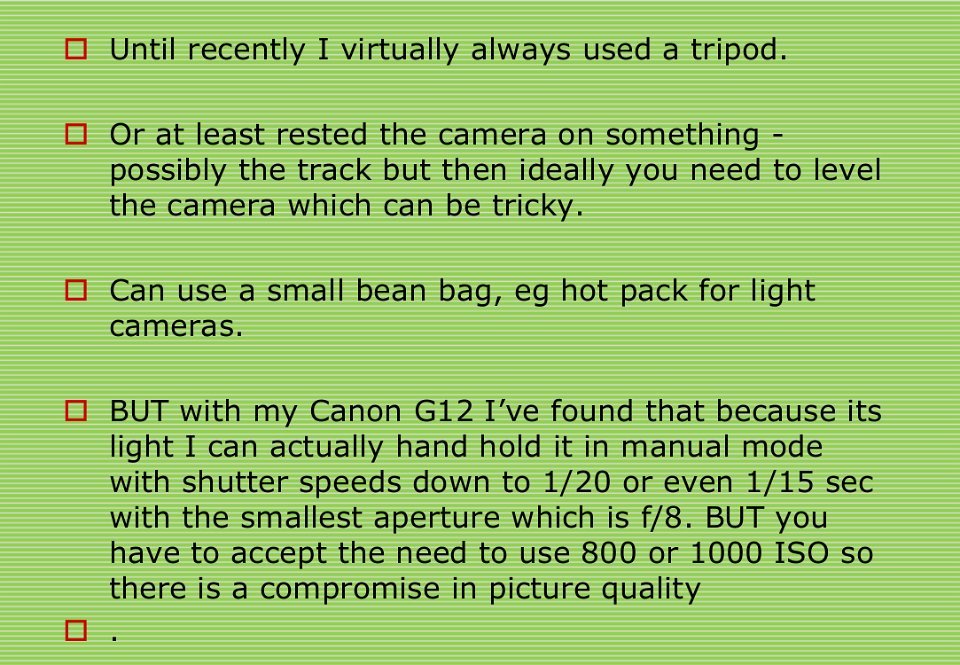
Presentation on Model Railway Photography - Slide17
17
Presentation on Model Railway Photography - Slide18
18
Presentation on Model Railway Photography - Slide19
19
Presentation on Model Railway Photography - Slide20  Cliff Parsons’ The Gresley Beat taken on the Nikon D7000 in 2013.   Photo on the Left  - heavy Nikon on light weight tripod – either the tripod was too light or the floor unstable as some photos taken that day were fine like the top right photo, others were quite blurry.   Bottom right is the top right photo after editing with Photoshop.
20 Cliff Parsons’ The Gresley Beat taken on the Nikon D7000 in 2013.

Photo on the Left - heavy Nikon on light weight tripod – either the tripod was too light or the floor unstable as some photos taken that day were fine like the top right photo, others were quite blurry.

Bottom right is the top right photo after editing with Photoshop.
Presentation on Model Railway Photography - Slide21  I generally don’t add any additional light – I try to get by with what is available.  Flash can produce substantial shadows.    Portable flood lights like those John Pavitt uses are good but considerably bulky and heavy to take away with you!  I did use one of this type of light when photographing some of Peter Lucas’ ‘Devises’ layout – which he talked about at the last convention.  Gavin Thrum, whom a lot of you would know, has a portable fluoro lamp on a home made fitting that he often uses to fill in light from the side of layouts when he takes photos – I’ve tried that.  A sheet of white paper can be used to bounce light from above onto the side of a loco or other rolling stock when photographing individual items.  An alternative to light sources is to use Photoshop to enhance photos. Now I only know some of the basics of Photoshop but it has allowed the production of photos that have been quite useable for publication in The Clearing House.
21 I generally don’t add any additional light – I try to get by with what is available.

Flash can produce substantial shadows.

Portable flood lights like those John Pavitt uses are good but considerably bulky and heavy to take away with you! I did use one of this type of light when photographing some of Peter Lucas’ ‘Devises’ layout – which he talked about at the last convention.

Gavin Thrum, whom a lot of you would know, has a portable fluoro lamp on a home made fitting that he often uses to fill in light from the side of layouts when he takes photos – I’ve tried that.

A sheet of white paper can be used to bounce light from above onto the side of a loco or other rolling stock when photographing individual items.

An alternative to light sources is to use Photoshop to enhance photos. Now I only know some of the basics of Photoshop but it has allowed the production of photos that have been quite useable for publication in The Clearing House.
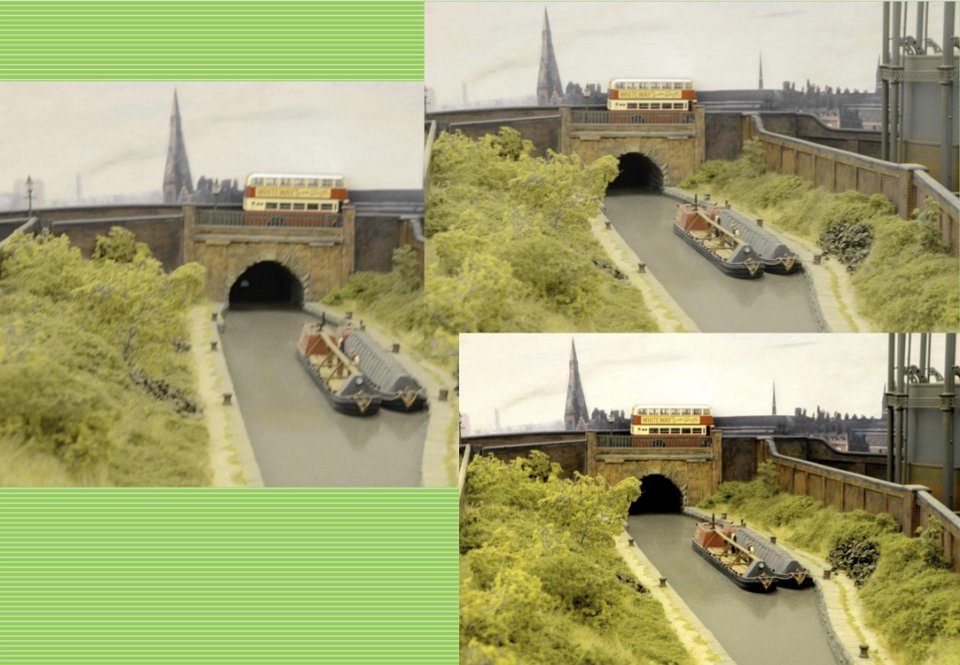
Presentation on Model Railway Photography - Slide22  A photo on Malcolm Roger’s Bolton Jct Railway. Top is the original from the Nikon and below after editing with Photoshop. Depth of field not that good in this photo.
22 A photo on Malcolm Roger’s Bolton Jct Railway. Top is the original from the Nikon and below after editing with Photoshop. Depth of field not that good in this photo.
Presentation on Model Railway Photography - Slide23  Cropping the photo to remove areas with less focus or simply to enlarge the main subject is easy with Photoshop.
23 Cropping the photo to remove areas with less focus or simply to enlarge the main subject is easy with Photoshop.
Presentation on Model Railway Photography - Slide24  The Canon G12 is an ideal camera for use in the process known as photostacking which is often used in model railway magazines. Photostacking is where a number of images are taken of the subject but with the focus set to different points in the view – typically 4-5 shots are taken.   A computer program then assembles the photos into one photo using the areas in focus from each shot so that the final product is a photo where all of the view is in focus – this is the technique currently used by a number of the photographers in the UK model railway magazines, eg Andy York and Phil Parker from BRM. On the Canon G12 its easy to change the spot where the camera focusses but the camera must not be moved as this upsets the stacking software. So it needs to be very well clamped to a tripod.   I’ve not tried this technique yet.    The photo you can see is one taken by Phil Parker using this technique when he visited Adelaide for the 2014 Convention. The layout is Kevin Kavanagh’s ‘Grange and Huntingdale’ SAR layout which I took Phil to see. You can appreciate that all of the photo is in focus.
24 The Canon G12 is an ideal camera for use in the process known as photostacking which is often used in model railway magazines. Photostacking is where a number of images are taken of the subject but with the focus set to different points in the view – typically 4-5 shots are taken.

A computer program then assembles the photos into one photo using the areas in focus from each shot so that the final product is a photo where all of the view is in focus – this is the technique currently used by a number of the photographers in the UK model railway magazines, eg Andy York and Phil Parker from BRM. On the Canon G12 its easy to change the spot where the camera focusses but the camera must not be moved as this upsets the stacking software. So it needs to be very well clamped to a tripod.

I’ve not tried this technique yet.

The photo you can see is one taken by Phil Parker using this technique when he visited Adelaide for the 2014 Convention. The layout is Kevin Kavanagh’s ‘Grange and Huntingdale’ SAR layout which I took Phil to see. You can appreciate that all of the photo is in focus.
Presentation on Model Railway Photography - Slide25
25
Presentation on Model Railway Photography - Slide26  This layout is behind glass so I took the photo with the lens pressed up against the glass to remove any reflections – I hope I didn’t scratch the glass!
26 This layout is behind glass so I took the photo with the lens pressed up against the glass to remove any reflections – I hope I didn’t scratch the glass!
Presentation on Model Railway Photography - Slide27  Again the main layouts at Pendon are all behind glass and unless you are on a special visit where you can have the glass doors opened you have to shoot though the glass.
27 Again the main layouts at Pendon are all behind glass and unless you are on a special visit where you can have the glass doors opened you have to shoot though the glass.
Presentation on Model Railway Photography - Slide28
28
Presentation on Model Railway Photography - Slide29
29
Presentation on Model Railway Photography - Slide30  Many of you will remember Pete Goss who came to speak to us two years ago in Brisbane – we were fortunate that Pete was at the Crawley Exhibition with Worlds End.
30 Many of you will remember Pete Goss who came to speak to us two years ago in Brisbane – we were fortunate that Pete was at the Crawley Exhibition with Worlds End.
Presentation on Model Railway Photography - Slide31
31
Presentation on Model Railway Photography - Slide32  Another view of Kingstorre – a scenic masterpiece – something I wouldn’t know much about! BRM released a DVD of this layout by Tony Wright some years ago – its well worth having a look at it.  These two photos of Kingstorre were taken on the tripod.
32 Another view of Kingstorre – a scenic masterpiece – something I wouldn’t know much about! BRM released a DVD of this layout by Tony Wright some years ago – its well worth having a look at it.

These two photos of Kingstorre were taken on the tripod.
Presentation on Model Railway Photography - Slide33  A beautiful village scene on Kingstorre – this time hand held – there was quite a bit of natural light coming into this upstairs room in Robert’s house so that meant the ISO didn’t need to be pushed too high. In this photo we’ve lost a bit of focus in the foreground but I still think it’s a very acceptable photo.
33 A beautiful village scene on Kingstorre – this time hand held – there was quite a bit of natural light coming into this upstairs room in Robert’s house so that meant the ISO didn’t need to be pushed too high. In this photo we’ve lost a bit of focus in the foreground but I still think it’s a very acceptable photo.
Presentation on Model Railway Photography - Slide34  Quick hand-held photos taken during a visit to the Leamington and Warwick Model Railway Club where we were welcomed by Phil Parker and his Dad who is the current President of the Club. It would have been nice to see Clarendon being operated but it was a quick visit.
34 Quick hand-held photos taken during a visit to the Leamington and Warwick Model Railway Club where we were welcomed by Phil Parker and his Dad who is the current President of the Club. It would have been nice to see Clarendon being operated but it was a quick visit.
Presentation on Model Railway Photography - Slide35  Pete Waterman’s layout is massive and of course is 7mm scale. The lighting in this room which is on a mezzanine floor in a barn was all fluoro and not that good so it made photography somewhat difficult but we work with what we have. Ideally I should have used the tripod here.
35 Pete Waterman’s layout is massive and of course is 7mm scale. The lighting in this room which is on a mezzanine floor in a barn was all fluoro and not that good so it made photography somewhat difficult but we work with what we have. Ideally I should have used the tripod here.
Presentation on Model Railway Photography - Slide36  This historic layout which was started in about 1946 by Peter Denny is in the custody of Tony Gee who has been painstakingly restoring it back to full operation but there is someway to go, particularly with the signalling.
36 This historic layout which was started in about 1946 by Peter Denny is in the custody of Tony Gee who has been painstakingly restoring it back to full operation but there is someway to go, particularly with the signalling.
Presentation on Model Railway Photography - Slide37
37
Presentation on Model Railway Photography - Slide38
38
Presentation on Model Railway Photography - Slide39  A couple of shots of Roy Jackson’s extravaganza in Retford – all 70 feet of it. There are some wonderful signals on this layout which unfortunately probably will never be finished.
39 A couple of shots of Roy Jackson’s extravaganza in Retford – all 70 feet of it. There are some wonderful signals on this layout which unfortunately probably will never be finished.
Presentation on Model Railway Photography - Slide40  Geoff Kent’s two layouts ‘Blakeney’ and ‘Black Lion Crossing’ are both located in Roy Jackson’s very large railway room in rural Lincolnshire.
40 Geoff Kent’s two layouts ‘Blakeney’ and ‘Black Lion Crossing’ are both located in Roy Jackson’s very large railway room in rural Lincolnshire.
Presentation on Model Railway Photography - Slide41
41
Presentation on Model Railway Photography - Slide42
42
Presentation on Model Railway Photography - Slide43  I was very fortunate that I had an invite to join Jonathan Wealleans on a visit to Bert Collins’ ‘Hitchin’ layout.   I had been inspired by this layout that appeared inan article in the November 1973 Model Railway Constructor. Bert had passed on some 10 years ago or so but one of his sons and a group of Bert's mates still operate the layout in the loft at Bert’s home.   The top photo shows the LNER O2/2 or ‘Tango’ as they were known.   This layout wasn’t the easiest to photograph to get nice views as it was showing its age but it was still possible to find some good locations.  These were taken hand-held on the Canon.
43 I was very fortunate that I had an invite to join Jonathan Wealleans on a visit to Bert Collins’ ‘Hitchin’ layout. I had been inspired by this layout that appeared inan article in the November 1973 Model Railway Constructor. Bert had passed on some 10 years ago or so but one of his sons and a group of Bert's mates still operate the layout in the loft at Bert’s home.

The top photo shows the LNER O2/2 or ‘Tango’ as they were known.

This layout wasn’t the easiest to photograph to get nice views as it was showing its age but it was still possible to find some good locations.
These were taken hand-held on the Canon.
Presentation on Model Railway Photography - Slide44
44
Presentation on Model Railway Photography - Slide45  Tony uses a Nikon Df digital SLR, which actually looks like a film SLR, and either a Nikon 35mm lens with a minimum aperture of f29 or a 55mm lens with a minimum aperture of f45 so that it gives substantial depth of field as witnessed in these photos. He also uses pulses of fill in flash.
45 Tony uses a Nikon Df digital SLR, which actually looks like a film SLR, and either a Nikon 35mm lens with a minimum aperture of f29 or a 55mm lens with a minimum aperture of f45 so that it gives substantial depth of field as witnessed in these photos. He also uses pulses of fill in flash.
Presentation on Model Railway Photography - Slide46
46
Presentation on Model Railway Photography - Slide47  The red backed chair on the right was where I sat for a lot of the time as Tony progressively paraded a lot of his historic models for me to view and comment on – a fantastic time.
47 The red backed chair on the right was where I sat for a lot of the time as Tony progressively paraded a lot of his historic models for me to view and comment on – a fantastic time.
Presentation on Model Railway Photography - Slide48  Tony’s house is roughly where the buildings are in the left foreground and his railway shed is about where the black building is in the centre so he couldn’t really get any closer to the location he’s modelling.   This photo is the view from the top of the embankment that carried the Midland and Great Northern to the bridge crossing the ECML.
48 Tony’s house is roughly where the buildings are in the left foreground and his railway shed is about where the black building is in the centre so he couldn’t really get any closer to the location he’s modelling.

This photo is the view from the top of the embankment that carried the Midland and Great Northern to the bridge crossing the ECML.